The Smart Shopper’s Checklist Before Buying Anything Online
Why Online Shopping Safety Matters More Than Ever in 2026
It’s worth understanding the scale of the problem before getting into the how-to. Online shopping scams are a significant consumer concern in the United States, with consumers reporting fraud involving undelivered orders, counterfeit goods, misleading listings, and products that differ substantially from what was advertised. Fraud researchers and security organizations have also reported growing use of generative AI in scams, making fake stores, advertisements, reviews, and customer-service interactions increasingly convincing.
Part of what makes this tricky is that AI tools have made scam storefronts, fake reviews, and even deepfake celebrity endorsements far more convincing than they used to be. AI-generated content can also make fake reviews, product descriptions, and advertisements more difficult to evaluate at a glance. Scam activity can also increase around major shopping events, when consumers are actively searching for deals and limited-time offers. Security researchers have repeatedly warned about fake shopping websites and other scams designed to take advantage of increased shopping activity around events such as Black Friday and Cyber Monday, including websites that imitate well-known brands.
None of this means you should stop shopping online. It just means a little healthy skepticism and a consistent pre-purchase routine go a long way.
Step One: Vet the Retailer Before You Vet the Product
Before you fall in love with a product photo or a “70% off, today only” banner, take a minute to check whether the store itself is trustworthy. This is the single step that prevents the most damage, because even a great return policy won’t help if the seller never intended to ship anything.
Look Beyond the Homepage
- Search the store’s name along with words like “reviews,” “scam,” or “complaints” to see what comes up.
- Check how long the domain has been registered. Brand-new sites with no history are not automatically scams, but they deserve extra caution, especially if they’re selling designer goods at steep discounts.
- Look for a real, physical business address and a working customer service phone number or email, not just a contact form.
- Check that the “About Us” page reads like it was written by a real company, not copied and pasted from a template with placeholder text left in.
Read Reviews, But Read Them Critically
Reviews can provide useful information about a product or retailer, but they should not be treated as automatically reliable. In the United States, the Federal Trade Commission’s Consumer Reviews and Testimonials Rule took effect on October 21, 2024, and prohibits certain deceptive practices involving fake or false reviews, undisclosed insider testimonials, some forms of review suppression, and fake social-media influence indicators. Other countries may apply different consumer-protection rules. Regardless of location, shoppers should look for detailed experiences, a healthy mix of ratings, consistent review patterns, and information from more than one independent source, because regulations do not prevent every fraudulent or misleading review from appearing online.
When you’re reading reviews, watch for these patterns:
- A flood of five-star reviews posted within the same short time window
- Reviews that read oddly generic or repeat the same phrases across different products
- Verified purchase badges missing from most of the glowing reviews
- An unusually high rating with almost no critical feedback at all
- Photos in reviews that look staged or reused across multiple listings
A mix of positive and mildly critical reviews, especially ones that mention specific details like sizing, delivery time, or packaging, tends to be far more trustworthy than a wall of perfect five-star ratings.
Check for Secure Checkout Signals
Before entering payment information, check that the checkout address begins with “https://.” The “s” indicates that the connection between your browser and the website is encrypted, which helps protect data while it is transmitted. However, HTTPS and the padlock icon do not prove that a retailer is genuine or trustworthy, because fraudulent websites can also use encrypted connections. Treat HTTPS as a basic technical security measure, not as evidence that the seller is legitimate, and combine it with checks of the domain name, retailer reputation, contact details, seller history, and return policy.
The Smart Shopper’s Pre-Purchase Checklist
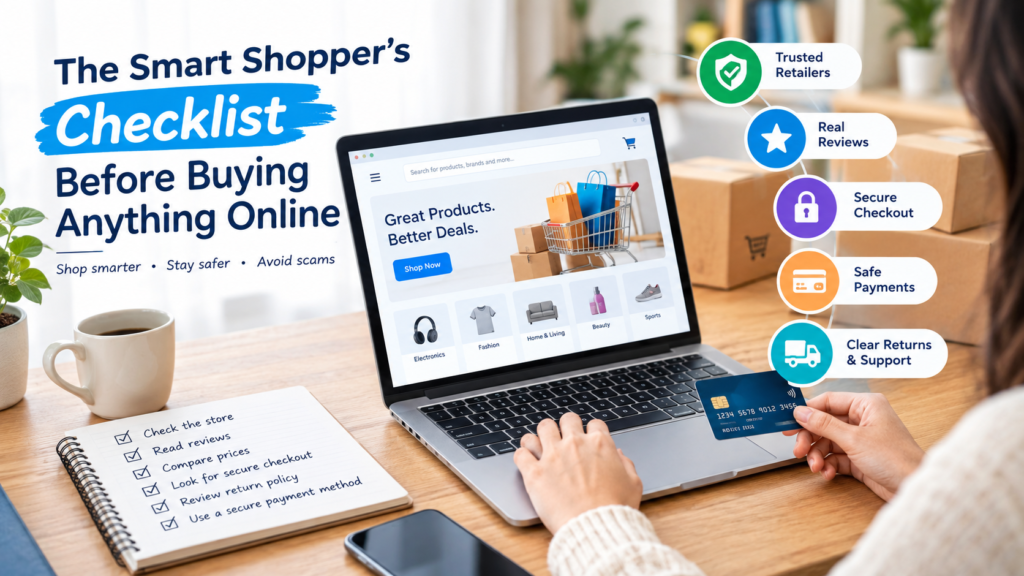
Once you’ve decided a retailer seems legitimate, run through this short checklist before finalizing any order.
1. Compare Prices Across a Few Sources
If a price looks dramatically lower than everywhere else, that’s worth a second look rather than an instant “add to cart.” Scammers often use steep discounts on popular, in-demand items to create urgency and short-circuit careful thinking. A quick search for the same product on two or three other retailers gives you a realistic price range and helps you spot listings that are too good to be true.
2. Read the Full Product Description
Pay attention to sizing, materials, specifications, and country of origin. Vague descriptions, stock photos that don’t match the listed brand, or spelling and grammar mistakes throughout the listing can be signs of a low-effort or fraudulent storefront.
3. Understand the Shipping and Return Policy
Before buying, know:
- Estimated delivery window and whether tracking is provided
- Who pays for return shipping if the item doesn’t work out
- The return deadline and whether it’s a store credit or a full refund
- Whether the seller is a marketplace third party rather than the platform itself
Marketplaces like Amazon, eBay, and Etsy host thousands of independent sellers, and return policies can vary quite a bit between them. Always check the specific seller’s terms, not just the general platform policy.
4. Screenshot or Save Your Order Confirmation
Keep a copy of the order confirmation email, the listed price, and the product description at the time of purchase. If the item arrives different from what was advertised, this record makes it much easier to dispute the charge or request a refund.
5. Check Seller Ratings on Marketplaces
On third-party marketplaces, look at the seller’s overall rating, how many transactions they’ve completed, and how long they’ve been active. A seller with thousands of positive transactions over several years is a very different risk profile than one with a handful of reviews and a store created last month.
Payment Methods: Which Ones Actually Protect You
How you pay matters almost as much as where you shop. Some payment methods come with built-in fraud protections, while others offer little to no recourse if something goes wrong.
| Payment Method | Fraud Protection Level | Good For | Watch Out For | |
|---|---|---|---|---|
| Credit Card | Often provides stronger dispute options than a debit card for unauthorized transactions and certain billing problems, but protections, deadlines, and liability rules vary by issuer, network, and country. | Many online purchases, particularly when the seller is unfamiliar or the item is expensive. | Interest charges can make a purchase more costly if the balance is not paid in full. | |
| Debit Card | May provide protection for unauthorized transactions, but the money is taken directly from your bank account and the dispute process varies by bank and jurisdiction. | Smaller purchases from established retailers when other payment options are unavailable. | A compromised card can affect funds in the linked bank account; report suspicious transactions promptly. | |
| Digital Wallets (Apple Pay, Google Pay, PayPal) | May use tokenization to reduce exposure of the underlying card number and may provide dispute tools, but coverage depends on the wallet, funding source, transaction type, and provider terms. | Purchases from retailers that accept a reputable wallet and where the wallet’s dispute terms are understood. | A wallet does not prove that the retailer is legitimate, and it may not provide a separate refund right beyond the underlying card or account. | |
| Buy Now, Pay Later (BNPL) | Protections, fees, late-payment consequences, credit reporting, and dispute procedures vary substantially by provider and jurisdiction. | Purchases from retailers you already trust when you have confirmed the total cost and payment schedule. | Treat it as credit, track all active plans, and avoid using it to buy something you cannot otherwise afford. | |
| Bank Transfer or Wire | Recovery can be difficult after the funds have been sent, particularly when the recipient is fraudulent or located in another jurisdiction. | Limited situations involving a verified business relationship and independently confirmed payment instructions. | An unfamiliar seller’s insistence on this method is a major warning sign; verify any changed bank details through a separate channel. | |
| Gift Cards or Cryptocurrency | Transactions may be difficult or impossible to reverse, and consumer protections vary widely. | Generally unsuitable when an unfamiliar retailer or stranger requests them as payment. |
|
Buy now, pay later services have grown enormously in popularity for online retail, and they can be a genuinely useful budgeting tool when used deliberately. The main risk isn’t the technology itself, it’s the ease of stacking multiple installment plans across different retailers without tracking the total, which can quietly strain a budget. If you use BNPL, it’s worth keeping a simple running list of active plans so payments don’t sneak up on you.
If a seller ever asks you to pay by wire transfer, cryptocurrency, or gift card for a standard retail purchase, treat that as a hard stop. Legitimate businesses accept normal, traceable payment methods, and this request is one of the most reliable scam indicators there is.
Spotting AI-Generated Scams and Fake Storefronts
The scam landscape has shifted noticeably over the past couple of years. Fraud researchers have tracked triple-digit percentage growth in scams that use generative AI, and shoppers are now dealing with threats that look and sound far more polished than the clumsy phishing emails of a decade ago.
Deepfake Ads and Celebrity Endorsements
Fraudsters increasingly use AI-generated video and audio to create fake celebrity endorsements for products that don’t exist or aren’t what they claim to be. If a video ad shows a well-known public figure enthusiastically promoting a miracle product, health supplement, or investment opportunity, treat it with real skepticism, particularly if you can’t find the same endorsement on that person’s verified accounts or in mainstream news coverage.
AI-Written Product Listings and Reviews
Because AI text generators can produce convincing product descriptions and reviews at scale, some storefronts now populate their entire catalog with AI-written listings and reviews that have never actually been used or tested by a real customer. Signs to watch for include:
- Product descriptions that sound suspiciously similar across completely different items in the same store
- Reviews that mention generic benefits without any specific detail about the actual experience of using the product
- Customer photos that look artificially generated, with subtle distortions in hands, text, or backgrounds
Fake Holiday and Flash Sale Sites
Scam storefronts can become more common and harder to recognize during major shopping events, when consumers are actively searching for discounts and limited-time offers. Fraudsters may copy a legitimate brand’s name, logo, product images, and design to make a fake store appear authentic. If you discover a retailer through an unfamiliar social-media advertisement, email, or message, avoid relying solely on the link provided. Instead, type the brand’s web address directly into your browser or find it through an independent search, then check that the domain, contact details, product range, payment options, and return policy are consistent with the genuine business.
Protecting Your Personal and Financial Information
Good shopping habits go beyond the checkout page. A few ongoing practices make a real difference in keeping your data safe over time.
Use Strong, Unique Passwords
Weak or reused passwords are consistently cited as a leading cause of account takeover fraud. Use a different password for every shopping account, and consider a password manager if remembering unique passwords for dozens of sites feels unrealistic, because it usually is.
Turn On Two-Factor Authentication
Where it’s offered, two-factor authentication adds a meaningful extra layer of protection, requiring a code from your phone or an authentication app in addition to your password. It won’t stop every attack, but it blocks a large share of the automated account takeover attempts that rely on stolen or guessed passwords alone.
Be Careful on Public Wi-Fi
A large share of people connect to unsecured public Wi-Fi networks at some point during the year, which can expose data to anyone else on that same network. If you need to shop while out and about, using your phone’s cellular data or a trusted VPN is generally safer than an open café or airport network.
Limit What You Share at Checkout
Legitimate retailers need your shipping address and payment details. They typically don’t need your Social Security number, your date of birth, or answers to detailed security questions just to sell you a pair of shoes. If a checkout form asks for information that feels excessive for the purchase you’re making, that’s worth pausing on.
Monitor Your Statements
Make a habit of reviewing your credit card and bank statements regularly rather than waiting for the monthly summary. Catching an unauthorized charge within a few days rather than a few weeks makes disputing it much easier and faster.
Red Flags That Should Make You Pause
Some warning signs are common enough across different types of scams that they’re worth memorizing:
- Pressure tactics like countdown timers, “only 2 left” messages that reset constantly, or urgent warnings that a deal expires in minutes
- A brand new social media account with a small following suddenly running heavily boosted ads
- Checkout pages hosted on a completely different, unfamiliar domain than the one you clicked through from
- Requests for payment by gift card, cryptocurrency, or wire transfer
- No visible return policy, refund policy, or customer service contact information
- Prices that are dramatically lower than every other retailer for the same exact item
- Poor spelling, awkward grammar, or inconsistent formatting throughout the site
None of these signs alone proves a scam, but when two or three show up together on the same site, it’s a strong signal to shop elsewhere.
Shopping Through Apps and Social Media: A Few Extra Precautions
A growing share of purchases now happen through mobile apps and social media shopping features rather than a traditional website, and this channel brings its own set of considerations.
Only Download Apps From Official App Stores
Stick to the Apple App Store or Google Play rather than downloading a retail app from a link in a text message or email. Before downloading, check the developer name, the number of downloads, and recent reviews. A retail app with very few downloads and a developer name that doesn’t match the brand is worth avoiding.
Be Cautious With “Shop Now” Buttons in Social Media Ads
Social platforms make it incredibly easy to buy directly from an ad without ever leaving the app, which also makes it easy to skip the usual verification steps. Before tapping “shop now” on an ad from a brand you don’t recognize, take a moment to search for the brand separately or check its official website and social profiles for consistency. Look at how long the advertiser’s account has been active and whether it has a reasonable following relative to how aggressively it’s advertising.
Watch for Subscription Traps
Some online offers, particularly free trials for beauty products, supplements, or software, are structured to auto-enroll you in a recurring subscription unless you cancel within a narrow window. Before accepting a “free trial,” read the fine print on how and when you’ll be charged, and calendar a reminder a few days before the trial ends if you want to cancel. Regulators have increasingly scrutinized these “dark pattern” tactics, but they still show up often enough that reading the terms before checkout remains the best defense.
What To Do If Something Goes Wrong
Even careful shoppers occasionally run into a bad transaction. If you suspect you’ve been scammed or received a counterfeit or damaged item, acting quickly improves your odds of a resolution.
- Contact the seller first. Many issues are genuine mistakes, and a clear, polite message describing the problem often resolves things without further steps.
- Document everything. Save screenshots of the listing, your order confirmation, any messages with the seller, and photos of the item you received.
- Dispute the charge with your card issuer if the seller doesn’t resolve it. Most credit card companies have a formal chargeback process for goods that never arrived or were significantly not as described.
- Report the scam. In the United States, you can file a report with the Federal Trade Commission at ReportFraud.ftc.gov. This helps regulators track patterns and, in some cases, take action against repeat offenders.
- Leave an honest review. If the platform allows it, sharing your experience can help other shoppers avoid the same problem.
The Quick Checklist: Save This Before You Click “Buy”
Here’s the condensed version you can keep handy for future purchases:
- Search the retailer’s name for reviews or complaints before buying
- Confirm the checkout page uses a secure, encrypted connection
- Compare the price against two or three other retailers
- Read the return and shipping policy before you pay, not after
- Use a credit card or a protected digital wallet rather than a debit card or wire transfer
- Never pay a retailer with gift cards or cryptocurrency
- Look for specific, detailed reviews rather than a wall of generic five-star ratings
- Save your order confirmation and product description in case you need to dispute the charge later
- Pause on any listing using countdown timers, urgent pressure, or prices that seem too good to be true
- Turn on two-factor authentication for accounts where you save payment information
Frequently Asked Questions
How can I tell if an online store is legitimate?
Look for a real physical address and working contact information, search the store’s name alongside terms like “reviews” or “complaints,” check how long the site has been active, and read a range of reviews rather than just the top-rated ones. Combining a few of these checks gives a much clearer picture than relying on any single signal.
Is it safe to use a debit card for online shopping?
It can be, especially with well-established retailers, but a credit card generally offers stronger fraud protection because it isn’t connected directly to your bank balance and typically comes with more robust dispute processes. For unfamiliar or new retailers, a credit card or a digital wallet is usually the safer choice.
What should I do if I think I’ve been scammed online?
Contact the seller first to try to resolve the issue directly. If that doesn’t work, dispute the charge with your card issuer and file a report with the Federal Trade Commission at ReportFraud.ftc.gov. Keep screenshots of the listing, your order confirmation, and any communication with the seller as supporting documentation.
Are online reviews still trustworthy in 2026?
Reviews remain a useful tool, but they require a more critical eye than they used to. Regulatory rules now prohibit businesses from buying or faking reviews, which has added some accountability, but fake and AI-generated reviews still show up. Look for reviews with specific details, a healthy mix of ratings, and verified purchase badges rather than trusting an overwhelming wall of five-star feedback.
What payment methods should I avoid when shopping online?
Avoid paying with wire transfers, cryptocurrency, or gift cards for standard retail purchases. These methods offer little to no way to recover your money if something goes wrong, and legitimate retailers do not typically request them.
How do I spot an AI-generated scam ad or fake celebrity endorsement?
Be cautious of ads featuring a public figure enthusiastically promoting a product, especially health, wellness, or investment products, if you can’t verify the endorsement through that person’s official accounts or credible news coverage. Subtle visual glitches, mismatched audio, or overly generic scripted language can also be signs of AI-generated content.
Does buy now, pay later come with the same protections as a credit card?
It depends on the provider. Some buy now, pay later services offer dispute processes similar to credit cards, while others offer less protection. It’s worth reading the specific provider’s terms before relying on it for a purchase you’re uncertain about, and it helps to track how many active plans you’re juggling at once so payments don’t catch you off guard.
Final Thoughts
Shopping online doesn’t have to feel risky once these checks become second nature. Most scams rely on shoppers moving quickly and skipping the small verification steps that take less than a minute. Vetting the retailer, reading reviews with a critical eye, choosing a payment method with real fraud protection, and pausing on obvious pressure tactics will cover you against the overwhelming majority of scams out there, including the more sophisticated AI-driven ones showing up in 2026.
Keep this checklist bookmarked, share it with anyone in your life who shops online often, and treat that extra minute of due diligence as part of the purchase itself, not an optional add-on.
Comments (0)