How AI Is Changing Online Shopping and Coupon Hunting in 2026
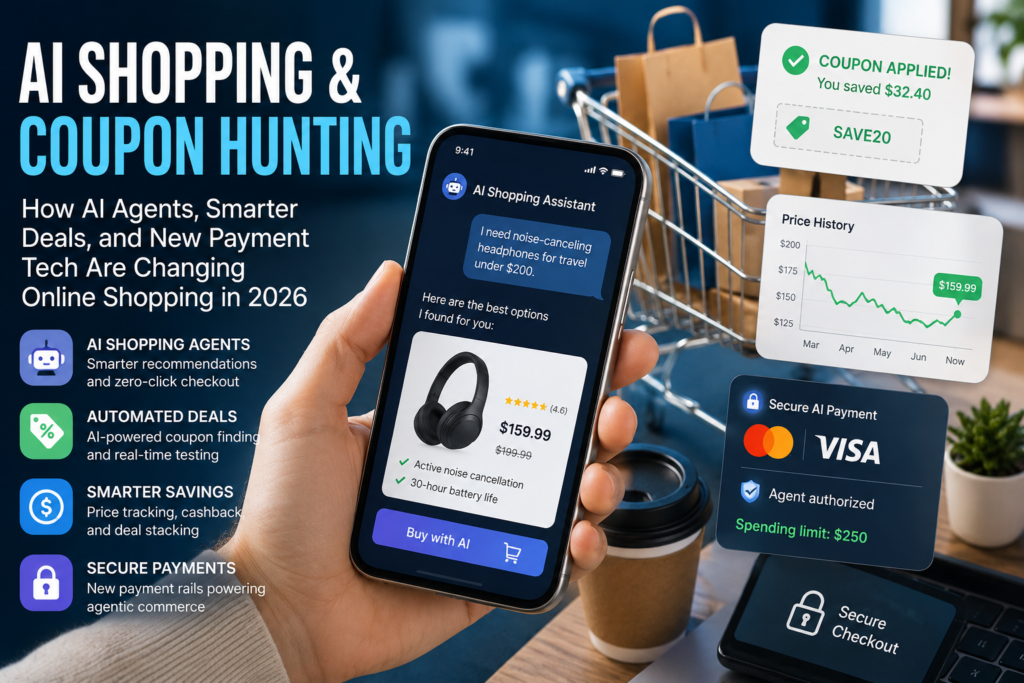
If you have shopped online at all this year, you have probably noticed something feels different. You are not just typing a product name into a search bar and scrolling through ten pages of results anymore. More people are asking a chatbot what to buy, letting a browser extension test coupon codes for them, or handing off the entire checkout to an AI agent while they do something else entirely.
This shift did not happen overnight, but 2026 is the year it became much harder to ignore. AI is increasingly influencing how shoppers discover products, compare prices, find deals, and make purchasing decisions, while coupon hunting is becoming more automated through browser extensions and AI-powered deal tools.
In this guide, we will walk through what is actually changing, what it means for everyday shoppers who just want a better deal, and how to make the most of these new tools without losing control over your own wallet.

The Rise of AI Shopping Agents in 2026
The clearest change in online shopping this year is how many people start their research inside an AI chat window instead of a search engine. Rather than typing a keyword and clicking through listings, shoppers are describing what they need in plain language, such as asking for wireless headphones that work well at the gym, or requesting the best current deal on a specific laptop.
Multiple 2026 studies indicate that AI is already becoming part of the online shopping journey. Adobe found that 39% of consumers surveyed had already used AI for online shopping, while AI-referred traffic to U.S. retail websites increased 393% year over year in Q1 2026. Consumers are increasingly using AI to research products, compare features, summarize reviews, evaluate prices, and discover relevant deals. While fully autonomous purchasing remains relatively uncommon, the growing use of AI throughout the shopping journey shows that AI-assisted commerce is moving beyond early adopters.
From Search Boxes to Conversations
The old shopping journey looked something like this: search, click, compare a few tabs, read some reviews, maybe abandon the cart, and come back later. It put nearly all of the work on the shopper.
AI shopping assistants compress that into a conversation. You describe a need or a budget, the assistant pulls together options, explains trade-offs, and in some cases can complete the purchase itself. For product categories that are genuinely confusing, like choosing between dozens of similar blenders or monitors, this kind of guided comparison can save real time.
Zero-Click and Agentic Checkout
“Zero-click shopping” is one of the phrases you will keep hearing in 2026. The idea is that a shopper never needs to visit a website or click a single link. Instead, they set a goal, such as reordering coffee pods when supplies run low or picking up a specific style of running shoe once a current pair wears out, and an AI agent monitors conditions and acts when it makes sense.
This is still an emerging behavior rather than the default way most people shop. Surveys show that while 51% of U.S. shoppers are willing to let AI handle the entire shopping process and many say they trust a personal AI agent to help choose products, only about 5–11% have actually allowed an agent to complete a transaction so far. Trust is building gradually, not instantly.
Why 2026 Feels Like a Turning Point
People have been predicting an “AI shopping revolution” for years, so it is fair to ask why this year feels different from the last few. Part of the answer is simple usage volume. Analysts studying chatbot activity have found that a meaningful share of daily conversations on major AI platforms are now shopping related, from questions about specific products to requests to compare prices between two options. Even a small percentage of billions of daily conversations adds up to tens of millions of shopping-related queries every single day.
The other part of the answer is infrastructure. Until recently, AI assistants could recommend products and guide shoppers through research, but completing a purchase on a shopper’s behalf required additional systems for authentication, payment authorization, and security. That gap began closing with the launch of Mastercard Agent Pay and Visa Intelligent Commerce in 2025, with both networks continuing to expand their agentic-commerce capabilities in 2026. At the same time, major technology and retail platforms are introducing experiences that allow shoppers to discover products, build carts, and, in some cases, complete purchases directly within AI-powered environments rather than being sent to a traditional product page first. Early results are mixed, however: AI-driven retail traffic is growing rapidly, while retailers are still working out how to balance easier AI-assisted purchasing with conversion, customer relationships, loyalty, and control over transaction data.
It is worth noting that adoption has not been perfectly smooth. Some large retailers have been candid about the fact that AI shopping agents still fall short of a fully satisfying customer experience in many cases, whether that is misunderstanding a request, recommending an out-of-stock item, or missing store-specific promotions. In other words, 2026 is a genuine inflection point, but it is an early one, not a finished product.
How AI Agents Are Reshaping Coupon Hunting
Coupon hunting used to mean opening a handful of tabs, copying codes from different deal sites, and hoping one of them still worked at checkout. That manual, trial-and-error process is exactly the kind of repetitive task AI is well suited to take over.
Automatic Coupon Testing at Checkout
Browser extensions have offered automatic coupon testing for years, but the newer generation of tools is noticeably smarter about it. Instead of blasting every code in a database at the checkout page, current tools try to match offers to what is actually in your cart, your order total, and whether you appear to be a new or returning customer, which cuts down on wasted attempts and expired codes.
Newer coupon tools are increasingly moving beyond static lists of promo codes by using automated testing and real-time shopper feedback to identify offers that are more likely to work at checkout. For example, SimplyCodes reported an 81.5% coupon-code success rate in March 2026 testing across 33,235 merchants, meaning that roughly four out of five codes tested successfully when an applicable discount was available. The company also maintains coverage across more than 500,000 online stores, although coverage and success rates can vary significantly by retailer. This approach helps address one of the biggest frustrations with traditional coupon hunting: finding codes that appear promising but are expired, restricted, or simply no longer work.
Price Tracking and Price History Tools
Coupon hunting and price tracking have become closely linked. Because large retailers change prices constantly, sometimes many times within a single day, a coupon code alone does not tell you whether you are actually getting a good deal. Price history tools solve that by showing how a product’s price has moved over weeks or months, so you can tell whether a “sale” price is meaningfully lower than normal or just a marketing label.
Here is a general look at the types of tools shoppers are combining in 2026:
| Tool type | What it does | Best used for |
|---|---|---|
| Coupon-testing extensions | Automatically finds and tries promo codes at checkout | Getting a percentage or dollar discount at the final step |
| Price history trackers | Shows how a product’s price has changed over time | Deciding whether now is actually a good time to buy |
| Cashback platforms | Returns a percentage of your purchase after checkout | Stacking extra savings on top of a coupon or sale price |
| AI shopping assistants | Compares products, summarizes reviews, and can complete purchases | Research-heavy purchases like electronics or appliances |
None of these tools are new inventions in 2026, but AI has made each of them faster and more accurate, and shoppers are increasingly using several together rather than picking just one.
Cashback and Coupon Stacking
Another habit that has become more common this year is stacking multiple types of savings on a single purchase. A typical stacked purchase might combine a store-wide coupon code, a cashback rate through a browser extension, and a rewards credit card offering extra points on that specific retailer. AI-powered tools make this easier to manage because they can automatically flag which combinations are allowed, since many retailers restrict stacking certain promotions together.
This is also where coupon and deal websites still play an important role. A well-maintained coupon site can clearly separate exclusive codes, store-wide sales, and category-specific promotions, which gives shoppers a cleaner starting point before an automated tool takes over at checkout.
Voice and Mobile Deal Hunting
Coupon hunting is also moving further into voice assistants and mobile apps. Instead of opening a laptop to search for a discount code, more shoppers are asking a voice assistant whether a product currently has any active promotions, or checking a retailer’s app for a personalized offer generated based on their past purchases. This mobile-first, voice-friendly behavior is pushing coupon and deal sites to make sure their content is easy to read on a small screen and easy for an AI system to summarize accurately in a short spoken answer.
The New Payment Rails Behind AI Shopping
One of the less visible but more important developments in 2026 is happening at the payment infrastructure level. For an AI agent to actually complete a purchase on your behalf, card networks and payment companies needed a way to verify that the agent is authorized, limit what it can spend, and let a shopper revoke that authorization instantly if something goes wrong.
Mastercard and Visa each rolled out frameworks designed specifically for this problem: Mastercard Agent Pay launched in 2025 and expanded in 2026 with Agent Pay for Machines, while Visa Intelligent Commerce also debuted in 2025 and added major partnerships, including with OpenAI, in mid-2026. Mastercard’s agent-focused program ties a tokenized card credential to a specific AI agent, a defined merchant scope, and a consent policy, so the agent never actually holds your raw card number. Visa has taken a similar approach with its own agent-verification protocol, which lets merchants confirm that a request is coming from a legitimate, authorized agent rather than a bot pretending to be one.
Several major retail and technology companies have also worked together on shared standards so that agentic purchases behave consistently across different platforms and card networks, rather than every company building its own incompatible system. It is a genuinely fast-moving space, and the specific standards in place may continue to shift, so it is worth checking for the latest details before assuming any one system is the final word.
For everyday shoppers, the practical takeaway is this: if you do choose to let an AI agent shop for you, look for the ability to set clear spending limits and to revoke access at any time from your card issuer’s app. Those consumer protections are becoming a standard feature, not an afterthought.
A Closer Look at the Tools Shoppers Are Actually Using
It helps to ground all of this in specifics rather than just discussing trends in the abstract. Here is a general overview of the categories of tools that have become popular in 2026, without treating any single product as the definitive best option, since the right fit depends on which retailers you shop most and what you are trying to save on.
- Multi-retailer coupon and cashback extensions. These browser add-ons work across thousands of online stores, automatically searching for and testing codes at checkout while also tracking cashback where available. They tend to be the easiest entry point for someone who has never used an automated deal-finding tool before.
- Dedicated price history trackers. These tools focus specifically on showing how a product’s price has moved over time, which is especially useful on marketplaces where prices can change several times within a single day.
- AI-native coupon assistants. A newer wave of tools goes a step further by attempting to match a specific offer to what is actually in your cart in real time, rather than blindly trying a long list of codes, which reduces failed attempts and speeds up checkout.
- Card-issuer shopping tools. Some credit card companies now offer their own built-in coupon and price comparison features, which can be a convenient option if you already use that card regularly, since no separate account or extension is required.
Whichever category you choose from, the general advice stays the same: pick one or two tools you trust, understand what data they collect, and avoid installing several overlapping extensions that could conflict with each other during checkout.
What This Means for Everyday Shoppers
All of this technology is only useful if it actually makes shopping easier and cheaper for the person using it. Here is what it means in practical terms.
- Less manual searching for codes. A well-built browser extension can test coupon codes for you automatically, saving the old routine of opening multiple tabs before checkout.
- Better context on whether a deal is real. Price history tools help you see whether a discount is meaningful or just a temporary markup followed by a “sale.”
- Faster comparison shopping. Asking an AI assistant to compare two or three specific products can be quicker than reading through several long review articles yourself.
- More decisions happening with less friction. This can be a benefit, but it also means it is easier to make an impulse purchase without pausing to think it through.
- New privacy and data questions. AI shopping tools often need access to your browsing behavior or purchase history to work well, so it is worth understanding what each tool collects.
What This Means for Retailers and Coupon Sites
Retailers and deal websites are adjusting quickly, and the changes go beyond just adding a chatbot to a homepage.
- Content needs to answer questions directly. When an AI assistant summarizes a coupon site to answer a shopper’s question, clear, well-organized information about current offers, expiration dates, and store details tends to get referenced more often than vague or cluttered pages.
- Structured data matters more. Coupon and store pages that use clean formatting, accurate discount values, and up-to-date codes are easier for both search engines and AI systems to read and trust.
- Verification is becoming a differentiator. With so many outdated codes floating around online, coupon sites that clearly show when a code was last verified or last used tend to build more trust with visitors.
- Personalization is expanding beyond email. Retailers are increasingly using behavioral and contextual data to tailor offers across channels in real time, rather than sending the same generic discount to everyone.
Risks and Things to Watch Out For
None of this is without downsides, and it is worth being clear-eyed about the risks rather than treating AI shopping tools as a guaranteed win.
Not Every AI Recommendation Is Unbiased
Some AI shopping assistants are built or sponsored by companies with commercial relationships to certain retailers or brands. That does not necessarily make the recommendations bad, but it is worth treating an AI’s suggestion the same way you would treat a human salesperson’s suggestion: helpful, but worth double-checking.
Automated Checkout Reduces the Pause Before Buying
Part of what keeps spending in check for a lot of people is the natural pause created by manually going through checkout. When that friction disappears, it becomes easier to spend more than planned. If you use an AI shopping agent regularly, setting a firm spending limit through your card issuer is a reasonable safeguard.
Fraud Patterns Are Still Catching Up
Because an AI agent does not behave exactly like a human shopper, some of the usual signals that banks and retailers use to catch fraud do not apply in the same way. Payment networks are actively building new verification layers to address this, but industry-wide dispute resolution and liability frameworks for agentic purchases are still being finalized, so keeping an eye on your statements is still a good habit.
Not Every Coupon Extension Is Trustworthy
Browser extensions that promise automatic coupons need fairly broad access to see what you are buying and where. Before installing one, it is worth checking reviews, understanding what data it collects, and avoiding extensions that ask for permissions that seem unrelated to finding discounts.
How to Make AI Work For You When Hunting Deals
You do not need to overhaul how you shop to benefit from these tools. A few practical habits go a long way.
- Install one reputable coupon-testing extension rather than several competing ones, since running multiple similar extensions at once can slow down checkout or cause conflicts.
- Pair it with a price history tool for bigger purchases like electronics or furniture, so you can confirm a sale price is actually a good one.
- Use an AI assistant for comparison, not just recommendation. Ask it to explain trade-offs between two specific products rather than just naming a winner.
- Set spending limits if you decide to let an AI agent complete purchases on your behalf, and know how to revoke its access quickly.
- Check a coupon site’s “last verified” or “last used” details before assuming a code will work, since even automated tools occasionally surface expired offers.
- Keep an eye on your statements a little more closely than usual while agentic shopping tools are still relatively new.
The Future: What’s Next Beyond 2026
Industry analysts expect AI’s role in shopping to keep growing over the next several years, though estimates for exactly how much revenue will flow through AI-driven and agentic channels vary widely depending on which research firm you ask. What most forecasts agree on directionally is that agentic and AI-assisted shopping is moving from a novelty into a standard part of the retail landscape, not a passing trend.
For coupon hunters specifically, that likely means even tighter integration between price tracking, automatic coupon application, and personalized deal alerts, all working together in the background rather than as separate tools you have to manage one by one. Coupon and deal websites that adapt by offering clear, verified, well-organized information are well positioned to remain useful in a world where both humans and AI agents are reading their pages.
It is also likely that shoppers will end up relying on a small handful of trusted tools rather than constantly switching between new apps and extensions as they launch. Just as most people eventually settled on one or two preferred retailers for most of their online purchases, the same pattern is likely to play out with AI shopping and coupon tools, once the current wave of experimentation and competition settles down.
Frequently Asked Questions
Is it safe to let an AI agent make purchases for me?
Major card networks have introduced verification systems designed to make agentic purchases safer, including the ability to set spending limits and revoke an agent’s access at any time. That said, this technology is still relatively new, so it is a good idea to start with smaller purchases, review your statements regularly, and only authorize agents through reputable, well-known platforms.
Do AI coupon extensions actually save money, or are the discounts exaggerated?
Results vary by retailer and by extension. These tools generally save you the time of manually searching for and testing codes, and many will apply a working discount when one is available. However, not every attempt results in a discount, since some retailers limit or block automated coupon testing at checkout, and some codes may already be expired.
Will AI shopping assistants replace traditional online shopping?
Not entirely, at least not yet. Many shoppers use AI assistants for research, comparison, and reordering routine items, while still browsing traditional retail sites directly for other purchases. The two approaches are increasingly used together rather than one fully replacing the other.
How do I know if a coupon code found by an AI tool is still valid?
Look for tools and coupon websites that show when a code was last verified or last successfully used. Codes that were tested very recently are generally more reliable than ones sitting on a static list that has not been updated in a while.
What information do AI shopping and coupon tools typically collect?
This varies by provider, but many tools need some visibility into your browsing activity on retail sites in order to detect what you are buying and apply relevant offers. It is worth reading a tool’s privacy policy before installing it, and avoiding extensions that request permissions unrelated to their core function.
Are AI shopping recommendations biased toward certain brands or retailers?
Some AI shopping tools have commercial partnerships with specific retailers or receive compensation for driving sales, similar to how some coupon and review sites operate. This does not automatically make a recommendation unreliable, but it is reasonable to compare an AI’s suggestion against independent reviews before making a larger purchase.
Final Thoughts
AI has not replaced the fundamentals of smart shopping. Comparing prices, checking whether a deal is genuine, and reading the fine print still matter just as much as they always have. What has changed is how much of that work can now happen automatically in the background, freeing up time for the parts of shopping that still benefit from a human decision.
The shoppers getting the most out of 2026’s tools are not the ones blindly trusting every AI suggestion. They are the ones using these tools as a starting point, verifying the details that matter, and staying in control of the final decision, whether that decision is made by them or, increasingly, by an agent acting on their behalf.
Comments (0)